

Co-Packaged Optics Standards Working Group
The Advanced Photonics Coalition (APC) Co-Packaged Optics (CPO) Standards Working Group unites technology leaders, system architects, and end users to define the next generation of high-performance connectivity. With CPO solutions expected to reach commercial availability within two years, our mission is to deliver a set of clear, practical standards that ensure interoperability, accelerate adoption, and enable innovation across a wide range of markets.
Our scope includes hardware, software, laser specifics, management frameworks, and system-level integration. In particular, software management is a cornerstone of this work, ensuring that CPO systems can be monitored, controlled, and scaled consistently across multi-vendor environments. Another key focus is enabling scale-up architectures, such as 72 GPU clusters and beyond, to meet the growing performance and efficiency demands of AI, cloud, and data center environments.
The APC CPO group is aligning with multiple open-source and industry-driven solutions, including Common Management Interface Specification (CMIS), YANG models, OpenConfig, NetConf, RESTConf, and other emerging frameworks. By defining how these tools apply to CPO, APC aims to simplify integration, streamline operations, and promote cross-industry interoperability.
By building a full ecosystem of APC member companies—from component suppliers to system integrators and end users—the APC CPO working group ensures that standards reflect the needs of the entire value chain.
CPO Working Group Charter Overview
The move from pluggable optics to co-packaged optics isn't a product refresh—it's a rearchitecting of how bandwidth is delivered inside the system. For years, the pluggable module boundary provided clean interoperability at the cost of power, signal loss, and physical density. At 51.2 Tbps switch capacity, that tradeoff is becoming untenable. At 102.4 Tbps and beyond, it breaks entirely.
The Advanced Photonics Coalition CPO Standards Working Group was formed because the industry recognized that solving the technical problem alone isn't enough. Without agreed-upon interfaces, management frameworks, and integration architectures, co-packaged optics risks fragmenting into a collection of proprietary implementations—each solving the physics, but none of them interoperable. The working group brings together component suppliers, optical engine vendors, switch OEMs, hyperscalers, and end users to prevent that outcome.
Commercial deployments are beginning in 2026. The standards work is happening now.


What CPO Actually Changes
In a conventional pluggable architecture, the optical transceiver is a discrete, removable module. It connects to the switch ASIC via a high-speed electrical SerDes link—typically 112G PAM4 today, with 224G on the near-term roadmap. That electrical link dissipates power, introduces insertion loss, and imposes signal integrity constraints that grow more severe as lane rates increase. The copper reach between ASIC and module shrinks with each generation.
Co-packaged optics eliminates that electrical link—or dramatically shortens it—by integrating the optical engine into the same package, or the same board assembly, as the switch ASIC. The photonic integrated circuit (PIC) and the ASIC communicate over a very short electrical interface, often just millimeters, which cuts the SerDes power budget and removes a significant source of signal degradation. The laser source—whether edge-emitting, VCSEL-based, or externally coupled via fiber attach—delivers light directly into the silicon photonic waveguides without traversing a pluggable connector.
Power Efficiency: Industry estimates consistently point to 30–50% reductions in optical I/O power at 51.2T and above when comparing CPO against equivalent pluggable implementations. At AI cluster scale—where the network fabric can represent a substantial fraction of total facility power—those efficiency gains translate into meaningful operational and capital savings.
CPO also removes the familiar pluggable boundary that the industry has relied on for fault isolation, replacement, and management visibility. That is where the standardization work becomes critical.
APC Working Group Scope and Focus Areas
The APC CPO Working Group addresses the full system stack required for scalable deployment. The scope is intentionally broad because CPO integration challenges don't respect traditional organizational or supply chain boundaries—a laser reliability issue surfaces as a system management problem, and a thermal design decision affects both the optical engine vendor and the switch OEM.

Hardware Architectures
The APC CPO Working Group addresses the full system stack required for scalable deployment. The scope is intentionally broad because CPO integration challenges don't respect traditional organizational or supply chain boundaries—a laser reliability issue surfaces as a system management problem, and a thermal design decision affects both the optical engine vendor and the switch OEM.

Laser Architectures
The APC CPO Working Group addresses the full system stack required for scalable deployment. The scope is intentionally broad because CPO integration challenges don't respect traditional organizational or supply chain boundaries—a laser reliability issue surfaces as a system management problem, and a thermal design decision affects both the optical engine vendor and the switch OEM.

Software and Management Frameworks
Removing the pluggable boundary also removes the standardized management interface that operators have relied on. Rebuilding that capability—consistently with existing data center tooling—is a core deliverable of the working group.

System-Level Integration and Deployment Models
Interoperability testing frameworks, reference integration architectures, and deployment qualification criteria for multi-vendor CPO systems.

APC CPO Standards Scope
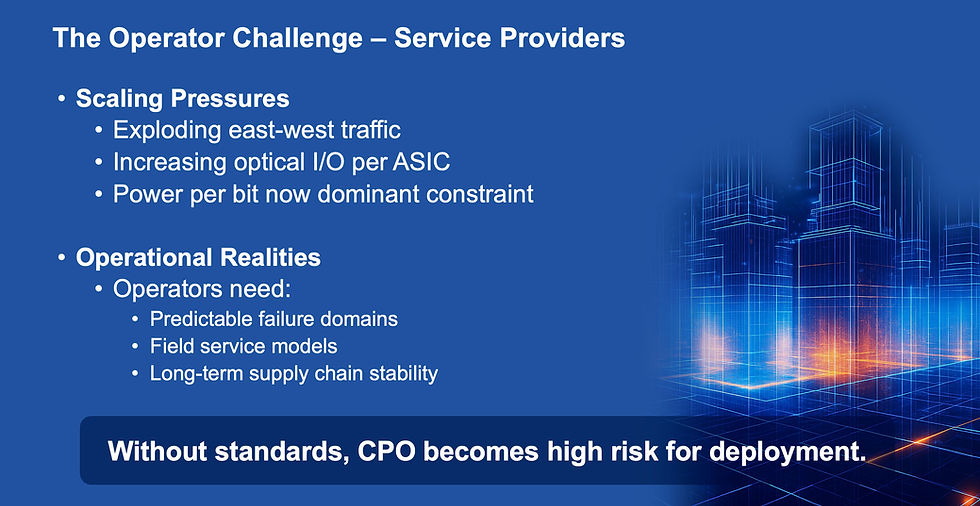
The working group's architecture targets are driven by real deployment requirements. The AI infrastructure buildout underway at hyperscale operators has created specific, near-term demands for bandwidth density and power efficiency that pluggable optics cannot meet within practical power envelopes.

CPO is load-bearing infrastructure for these deployments. The bandwidth density achievable with co-packaged integration—driven by the ability to use more optical lanes at lower power per lane—is a prerequisite for the next generation of AI accelerator fabrics.
Software-Defined Manageability
The management problem introduced by CPO is not subtle. In a pluggable world, CMIS (Common Management Interface Specification) provides a well-understood, standardized interface for transceiver status, diagnostics, control, and alarm reporting. Operators have built tooling, NOC workflows, and automation pipelines around that interface. When a module fails, the management plane sees it immediately and can correlate it with link-layer events.
CPO dissolves the pluggable boundary. The optical engine is no longer a discrete, addressable module with a standardized register map. Its functions are distributed across the PIC, the laser source, the DSP (if present), and the switch ASIC—potentially from multiple vendors, integrated by a system OEM. Without standardized management interfaces, that integration produces opaque systems that are difficult to monitor, nearly impossible to troubleshoot remotely, and resistant to automation.
The APC CPO Working Group is profiling and extending existing management frameworks for CPO-specific requirements:
-
CMIS extensions — optical engine telemetry, laser health reporting, and co-packaged-specific diagnostics, without breaking backward compatibility with existing CMIS implementations
-
YANG data models — vendor-neutral structured schemas for per-lane optical power, laser bias, wavelength accuracy, and thermal readings
-
OpenConfig — for operators running open network operating systems and programmable network management
-
NETCONF/RESTCONF — configuration and state retrieval in environments already using these protocols for switch management
The intent is not to create a parallel management ecosystem. It is to ensure that CPO systems appear, from an operational standpoint, as first-class citizens in the same management plane that already handles the rest of the network. Specific management capabilities under definition include:
-
Real-time optical engine telemetry and per-lane diagnostics
-
Laser bias current and output power monitoring with configurable alarm thresholds
-
Thermal zone awareness and power state management
-
Structured fault isolation distinguishing PIC failure, laser degradation, and fiber interface faults without requiring physical access
Ecosystem-Driven Standardization
The working group spans the full CPO value chain because the standards have to work across it. Participation includes:
-
Laser and III-V compound semiconductor component suppliers
-
Silicon photonics foundries and PIC vendors
-
Optical engine and subsystem integrators
-
Switch ASIC vendors and system OEMs
-
Hyperscaler and enterprise end users who will operate these systems at scale


That end-to-end participation is what separates standards that get deployed from standards that get published. The hyperscalers bring operational requirements derived from real fleet management experience. The component suppliers bring insight into what is physically achievable and at what cost. The system OEMs bring integration constraints that are often invisible to either end of the supply chain individually. The working group's process is designed to surface those constraints early—before they become interoperability problems in the field.
Strategic Positioning
The transition from pluggable to co-packaged optics is underway. Early CPO deployments are entering production in 2026, and the architectural decisions being made now—about interfaces, management frameworks, and integration models—will define how this technology scales across the industry over the following decade.
The risk is not that CPO fails technically. The physics work. The risk is that it succeeds as a collection of incompatible proprietary implementations, each optimized for one vendor's stack and unmanageable in a heterogeneous environment.
By defining the standards that bridge photonics, electronics, and software, the APC CPO Working Group is building the foundation for the next generation of AI-scale, energy-efficient computing infrastructure—one that is interoperable across vendors, operationally manageable at scale, and aligned with real-world deployment timelines.
The Advantages of Co-Packaged Optics Include:
-
Higher bandwidth density for AI, cloud, and high-performance computing
-
Lower power consumption and improved energy efficiency
-
Greater scalability to support 1,024+ GPU clusters and future architectures
-
Open-source aligned management frameworks for interoperability and ease of deployment
-
Improved reliability and thermal performance
-
Cross-vendor interoperability, reducing fragmentation and accelerating adoption
-
Demonstrate solutions utilizing the current model of APC Silicon Photonics and CPO ecosystem
This work benefits industries such as medical technology, defense, enterprise IT, and financial institutions—markets where low latency, reliability, and energy efficiency are mission-critical.
The Co-Packaged Optics Evolution

Source Credit: TBD
The Co-Packaged Optics Market Doubles in the Next 5 Years

Source Credit: Research and Markets
Why Join Advanced Photonics Coalition
Joining the APC CPO Standards Working Group provides companies with a unique opportunity to influence the direction of this transformative technology at a pivotal moment in its development. Members gain early visibility into evolving standards, the ability to shape specifications to align with their products and markets, and direct collaboration with peers across the ecosystem.
By contributing now, companies not only protect their investments and ensure compatibility, but also position themselves as leaders in delivering the performance, efficiency, and scalability that is needed for the future of networking across a variety of vertical markets.